


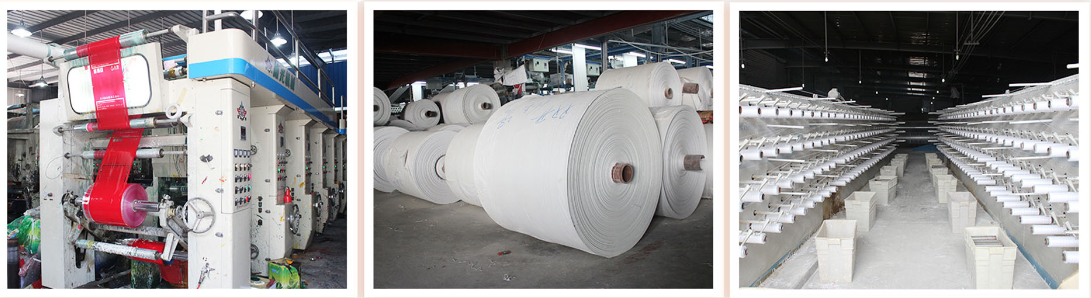
1. Introduction to Woven Bags and Their Processing Technology
Plastic woven bags are made primarily of polypropylene (PP), produced through extrusion, filament drawing, weaving, and bag making. PP is a semi-transparent, semi-crystalline thermoplastic with high strength, good insulation, low water absorption, high heat setting temperature, low density, and high crystallinity, making it the main raw material for woven bags. Modified fillers typically include glass fiber, mineral fillers, and thermoplastic rubber.
Plastic woven bags have a wide range of applications. Currently, they are mainly used for agricultural product packaging, cement bag packaging, food packaging, geotechnical engineering, tourism transportation, and flood control materials.
Woven bags are mainly classified into three categories: plastic woven bags (unlaminated woven bags), composite plastic woven bags, and various woven fabrics.
The production process of plastic woven bags is as follows: woven fabric is printed, cut, and sewn to become woven bags. Depending on the equipment used, cutting can be done before printing, or printing can be done before cutting. Automatic cutting and sewing can continuously complete printing, cutting, and sewing processes. It can also produce valve bags, bottom-filled bags, etc. For plain woven fabrics, center-seam bonding can be performed before bag making.
The production process of composite plastic woven bags involves laminating or coating woven fabric, coating material, and paper or film. The resulting tubular or sheet fabric can be cut, printed, and sewn to make ordinary sewn-bottom bags. It can also be punched, hemmed, cut, printed, and sewn to make cement bags. The resulting sheet fabric can be center-seam bonding, printed, cut, and bottom-glued to make glued-bottom bags. It can also be welded and rolled to make tarpaulins and geotextiles.
Plain woven fabrics can be coated or uncoated to produce tarpaulins, geotextiles, etc. Tubular fabrics can also be torn and coated or uncoated to produce tarpaulins or geotextiles, etc.
2. Woven Bag Processing Methods and Techniques
2.1 Granulation
Plastic granulation is a crucial step in the plastic product processing. Most plastic raw materials need to be granulated after synthesis before use, and this technology directly affects the quality of plastic products. The main granulation process includes: batching, extrusion, filtration, water cooling, traction, pelletizing, drying, and packaging.
Polypropylene powder, various additives, and activated calcium carbonate are added to a high-speed mixer in a specific ratio and sequence. After mixing at low to high speed for a certain period, the mixture is placed into a hopper and conveyed by a screw feeder. The material enters the barrel through the feed inlet, where it is melted and plasticized by the barrel and screw, continuously and stably extruded into strips. The strips are cooled and shaped in a water tank, then dehumidified by a dehumidifying fan, cooled by the fan, and then pelletized by a pelletizer. After screening by a vibrating screen, the strips are conveyed by a conveying fan to a fluidized bed for fluidized bed drying. Finally, the strips enter a material tank, and a feeder sucks the material from the tank into a storage tank. After the pellets pass inspection, they are quantitatively packaged, completing the entire production process. 2.2 Yarn Drawing Yarn drawing, also known as flat yarn drawing or fiber cutting, is a key process in woven bag production lines; similarly, the yarn drawing unit is the core equipment of a woven bag manufacturing plant. The quality of the yarn drawing process directly affects the internal and external quality of the product.
The flat yarn process includes: raw material modification, blending, coloring, filling, formulation, anti-aging and anti-degradation issues, temperature, pressure, and flow rate control during extrusion, rheological behavior during extrusion, power consumption and yield issues, draw ratio, blow-up ratio, draw ratio, crystallization cooling, orientation, heat treatment and shaping issues, forming during winding, and quality inspection of the yarn spindles.
After the raw material enters the extruder, it is subjected to external heating at 190-250℃ and shearing between the screw and barrel. After almost complete plasticization, the material is extruded quantitatively and under constant pressure. After forming at the die head, it becomes a molten film that enters the cooling water. After cooling, the film is cut into filaments by blades. The filaments are then stretched at high temperatures in a high-temperature oven until they form flat yarns. The flat yarn is then heat-set on hot rollers, pre-shrinks at low traction speed, and is processed at low temperature by cold rollers. Finally, it is wound into shape by a differential tension winding system.
Flat yarn production processes can be categorized by film formation method (tube film, flat film); by post-film cooling method (air cooling, water cooling, and intermittent cooling); by drafting and heating method (hot plate, hot rollers, hot air); and by spindle winding method (centralized cycloidal winding, single-spindle torque motor winding, and magnetic torque winding).
Post time: Jan-05-2026